
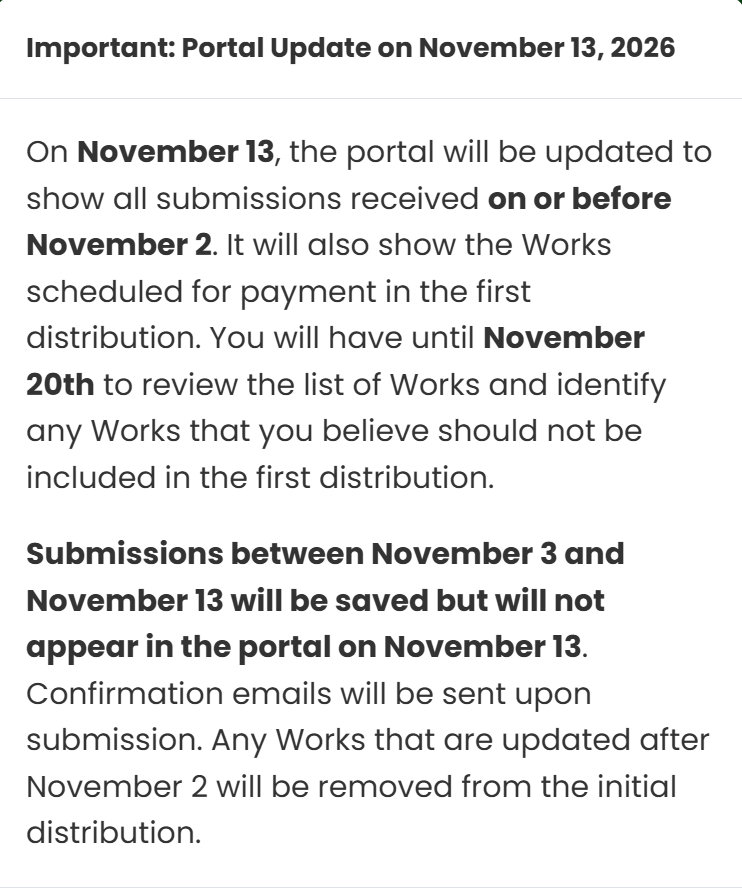
Fifth update (11/4):
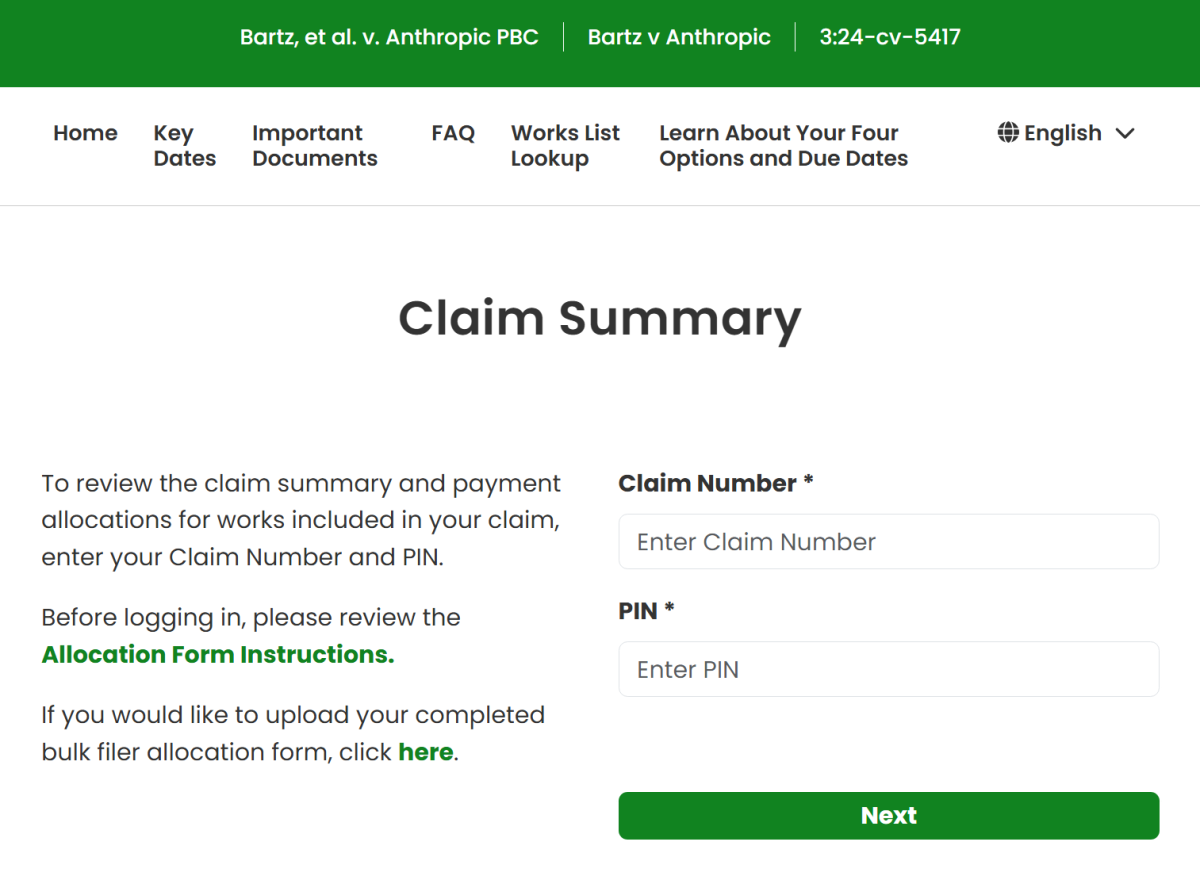
Important update at the Anthropic settlement web site:
Fourth update (10/28):
There’s no denying that publishers will be the big winners in the Anthropic settlement. I do not believe the lawyers did an adequate job of ensuring an equitable split between publishers and authors in their haste to get publishers to claim tens of thousands of books in order to ensure a smooth final approval process and no blanket opt-outs by publishers.
Because, yes, this is exactly what happened. It was obvious when claimed books jumped from around 50% to 93% in a relatively short period of time.
Even at 50/50, the split could be considered inequitable…but manageable. At least, as long as the publisher isn’t claiming books that have been out of circulation for years.
The real problem is the greed of too many publishers, such as Pearson, Peachpit Press, and so on. They’re relying on contracted royalty rates when claiming the lion’s share of the settlement funds. But copyright payout is not the same as a royalty.
Consider this: publishers pay authors a certain percentage of what a book makes as a royalty and that percentage is usually a small amount, such as 10, 15, or even 25%. Their reasoning is that they assume all of the costs of production, whether it’s hosting a book for digital access, or printing, warehousing, and shipping a paper book for sale.
There is absolutely no production costs associated with a copyright violation. The only ‘cost’ is the loss of profit for a sale or sales, and this is cost that authors and publishers equally share. So, the idea of a 50/50 split between author and publisher is a fair option. And if the lawyers had insisted on this breakdown for all books, not just ones for willing publishers, the settlement process would have much simpler, and authors would have perceived it to be fairer.
But the lawyers allowed the publishers to create this arbitrary ‘educational’ category solely so they could grab the lion’s share of the proceeds for each book…not only ensuring a windfall, but the fatest windfall they could get.
And the problem is that none of this was known BEFORE the final approval hearing, so that authors could object to the split while action could have been taken to avert it.
So what can authors do? As I’ve told a couple of friends: take it to the Special Master. Make the publishers dig up every single contract for every contested book. Prepare the best argument you can about how arbitrary and unfair the percentage split is. If folks could afford a lawyer, I’d recommend getting one, but I know most can’t. So make the best argument you can make about proceeds from a copyright class action are not the same as royalties, and payouts should not be based on royalty percentages.
And if the publishers cannot produce a contract, then suggest the only fair option at this point is the 50/50 split.
You may not win, but you may not lose, either. At worst, you’ll be paid your pittance later, and you’ll need to invest some time.
Just be aware that, after reading the letter sent by TTA to the court, you should probably specifically send an email to the Anthropic settlement administration telling them you want the claim to go to the Special Master for determination of split. AND that you want to present an argument directly to the Special Master, rather than upload any arguments now.
We can no longer assume this will happen automatically.
Third update (10/27):
A lawyer submitted a letter to the court for the Textbook & Academic Authors Association, and it’s a doozy.
I am lucky. Only one of my books was deemed ‘educational’ and it was a work-for-hire and I shouldn’t receive compensation for anyway, so I withdrew my claim on it. For the rest of my books, I and my publisher agree: they are legal owner, I am beneficial, and we split, 50/50.
But the authors dealing with the incredibly greedy SOBs like Pearson and Peachpit et al…I have nothing but sympathies.
Now, I’m reading that the poor authors are getting mixed and contradicting information, including that we’re required to ask for the Special Master? Authors having to specifically request the Special Master was not defined in ANY court document or any of the FAQs associated with this case.
It is obvious that authors are being shunted aside in favor of publishers in this class action when it comes to works the publishers deem ‘educational’. Here is where the class lawyers failed authors. And the settlement administration just continues that failure.
Read the letter. Read the emails from authors to the association.
Second update (10/26):
Anthropic just publicly filed for a listing on the US stock market. What this means for authors is that if the gross proceeds of this public offering exceed $10 billion dollars, it meets the threshold for a Liquidity Event, as outlined in a court document:
“Liquidity Event” means the consummation of (a) Liquidation Transaction (as defined in Anthropic’s certificate of incorporation as amended from time to time) or (b) an initial public offering of Anthropic common stock pursuant to a registration statement under the Securities Act of 1933, as amended, that results in gross proceeds to Anthropic of at least ten billion dollars
($10,000,000,000).
If so, this triggers the last Anthropic payment of $450 million into the settlement funds.
Defendant shall pay an additional four hundred fifty million dollars
($450,000,000.00) (“Scheduled Payment 2”) no later than twenty-four (24) months after the entry of Preliminary Approval (the “Schedule Payment 2 Date”), provided that, in the event a Qualified Financing or Liquidity Event occurs subsequent to the payment of Scheduled Payment 1 and prior to the Scheduled Payment 2 Date, Scheduled Payment 2 shall be payable within thirty (30) days of the final closing of such Qualified Financing or Liquidity Event.
If the IPO closing occurs a couple of weeks after the opening, this would put the final payment in middle to late December, 2026.
An important caveat: two legal firms have filed an appeal of the final approved settlement, specifically related to legal fees. However, there is little activity related to these appeals, leaving the status of the appeals a bit uncertain. And in one appeal, the lawyers are not asking for additional legal fees.
Update (10/24):
The Anthropic claims lawyers just asked the court for permission to update the allocation FAQ. You can read the proposed FAQ at the Free Law Project.
They do address some of the concerns about adjustments not showing up in the allocation page, and how to contact other authors/publishers to resolve issues. Frankly, it’s not perfect. Even though the CEO of the company administering the claim assured me that several books seemingly in disagreement are now in agreement, they’re still not reflected accurately in the allocation page. And the way to get contact information for the other claimants is by asking the settlement folks.
I think the email response to the allocation submission is good. This started October 16.
I do appreciate the update. I think it does answer some of the questions. Unfortunately, it’s not as good as we could hope. I’m still wary about books seemingly in disagreement being in agreement but not accurately recorded in the system.
Information in the motion itself relevant to what’s happening is the note that the settlement administrator will send notices of the agreed on allocations on or before November 13, and the initial distributions will occur the week of November 23.
WHEREAS, the Parties anticipate that the Settlement Administrator will send notices of agreed allocations on or before November 13, 2026, and the initial distribution of the Settlement payments during the week of November 23, 2026.
Earlier:
Frustrated by the lack of any useful information from the Anthropic settlement administrator, I sent the following email on October 9:
I am a class member in Bartz v. Anthropic PBC (claim #).
You show the following two works as works without any disagreement, which I agree with:
Copyright ID title of work
I am writing [about] the books that you still show in disagreement.
Seven of my works are listed as in disagreement among claimants even though the claimants (I and my publisher) agree on the allocation, and both have indicated so.
Copyright ID title of work date(s) of successful allocation adjustment submissions
In addition, I believe the following works are also without disagreement after updates by the publisher and other actors, but since I don’t have any view into the allocation reconciliation process, you’re not providing an updates on the progress, and multiple actors are involved, I can’t confirm the status:
Copyright ID title of work date(s) of successful allocation adjustment submissions
Because the first distribution is scheduled for on or before November 15, 2026, for works with agreed allocations and complete payment information, I am concerned that these works will be left out. I would appreciate answers to the following by 10/16/26:
1. Can you confirm that the allocations I submitted are consistent with the other claimants’ for each work above, and correct the status of each work?
2. If any work will not be corrected in time, what is the specific reason, and what is the earliest date it will be paid?
3. Will I receive written confirmation when each status changes?
My payment information is complete. I have copies of each submission, noting the success of the submission, including one completed by your own personnel. I have received an email back from the system administrator that my updates have been successfully recorded.
I would prefer to resolve this directly. If I do not receive a response by 10/16/26, I may ask the Court for a status conference or a short report on works in this situation, and I will include this correspondence with that request.
Thank you for your help.
I received a reply from the CEO of JNDL, Jennifer M. Keough, three days later. It provided everything I asked for, which finally gave me insight into what exactly was happening with the books.
I forwarded the email to my publisher, who was also happy to get the information because evidently, they also have little insight into what was happening with the books.
I was not bluffing on filing a motion in court. I already had the court document drafted, I’ve had a PACER account for years, I know how to get permission to file a document in the Northern District of California—one of the federal courts that allows non-lawyers to file using the PACER front end—and I was comfortable both with the type of motion to file, and the court’s continuing jurisdiction over the case allowing the judge to respond.
None of this should have been necessary. The inability to see what’s happening with the records after making adjustments, the lack of transparency to see what was happening with the other claimants, and no updates to the allocation adjustment web pages combined to unnecessarily stress people AND add to confusion about what is still needed to move books with disagreements to agreements.
This is supposed to be a ‘meet and confer’ time, with no contact information provided for all the claimants, and no insight into any adjustments they have made. Rather than ‘meet and confer’, it’s become more ‘throw something at it and hope it sticks’.
In my case, I did find that my allocation updates were applied, my publisher concurred, and several books did move from disagreement to agreement, though the allocation page still shows most of the books in disagreement. The few still in disagreement will likely have to be handled by the publisher producing original contracts—including the one where some bizarre leftfield publisher called ‘Forgotten Books’ has claimed to be a publisher on my book.
So, take heart fellow authors: even though the Anthropic settlement allocation updates page never updates, something is happening in the background to move at least some of the books.
Ms. Keough also noted that at the end of 60 days, all rights holders will receive an email listing books that are in agreement, and the percentage the individual will get for the books. These will form the basis of the first funds distribution in November.
My suggestion to her back was to provide detailed information for each book still in disagreement: what each claimant is stating or what additional information is needed, what the next steps are, and how will next distributions be handled. In addition, I also suggested to her that it would be effective to note that payments for books meeting a later payout should be slightly higher, to account for interest on funds still held in the settlement account.